


_______________________
UK Bandplan
RSGB Six Metre Band Plan (effective from 1st January 2020)
| The following band plan is largely based on that agreed at IARU Region 1 General Conferences. | ||
| 50 MHz (6m) | Necessary | UK Usage |
| Bandwidth | ||
| 50.000-50.100 | 500 Hz | Telegraphy Only (except for Beacon Project) Note-2 |
| 50.000-50.030 MHz reserved for future Synchronised Beacon Project (Note 2) | ||
| Region-1: 50.000-50.010; Region-2: 50.010-50.020; Region-3: 50.020-50.030 | ||
| 50.050 MHz Future International Centre of Activity | ||
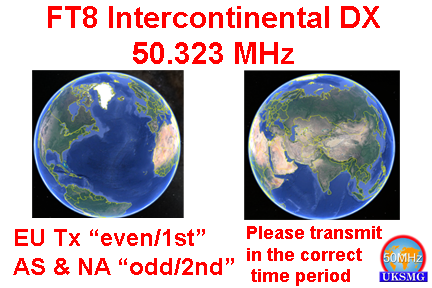
| 50.090 MHz Intercontinental DX Centre of Activity (Note 1) | ||
| 50.100-50.200 | 2.7 kHz | SSB/Telegraphy - International Preferred |
| 50.100-50.130 MHz Intercontinental DX Telegraphy & SSB (Note 1) | ||
| 50.110 MHz Intercontinental DX Centre of Activity | ||
| 50.130-50.200 MHz General International Telegraphy & SSB | ||
| 50.150 MHz International Center of Activity | ||
| 50.200-50.300 | 2.7 kHz | SSB/Telegraphy - General Usage |
| 50.285 MHz Crossband Centre of Activity | ||
| 50.300-50.400 | 2.7 kHz | MGM/Narrowband/Telegraphy |
| 50.305 MHz PSK Centre of Activity | ||
| 50.310-50.320 MHz EME | ||
| 50.320-50.380 MHz MS | ||
| 50.400-50.500 | Propagation Beacons Only | |
| 50.500-52.000 | 12.5 kHz | All Modes. |
| 50.510 MHz SSTV (AFSK) | ||
| 50.520 MHz Internet voice gateway (10 kHz channels), (IARU common channel) | ||
| 50.530 MHz Internet voice gateway (10 kHz channels), (IARU common channel) | ||
| 50.540 MHz Internet voice gateway (10 kHz channels), (IARU common channel) | ||
| 50.550 MHz Image/Fax working frequency | ||
| 50.620-50.750 MHz Digital communications | ||
| 50.630 MHz Digital Voice (DV) calling | ||
| 50.710-50.890 MHz FM/DV Repeater Outputs (10 kHz channel spacing) | ||
| 51.210-51.390 MHz FM/DV Repeater Inputs (10 KHz channel spacing) (Note 4) | ||
| 51.410-51.590 MHz FM/DV Simplex (Note 3) (Note 4) | ||
| 51.510 MHz FM calling frequency | ||
| 51.530 MHz GB2RS news broadcast and slow morse | ||
| 51.650 & 51.750 MHz See Note 5 (25kHz aligned) | ||
| 51.770 & 51.790 MHz See Note 5 | ||
| 51.810-51.990 MHz. FM/DV Repeater Outputs (IARU aligned channels) | ||
| Note 1: Only to be used between stations in different continents (not for intra-European QSOs). | ||
| Note 2: 50.0-50.1MHz is currently shared with Propagation Beacons. These are due to be migrated by Aug-2014 to 50.4-50.5 MHz, to create more space for Telegraphy and a new Synchronised Beacon Project | ||
| Note 3: 20 kHz channel spacing. Channel Centre frequencies start at 51.430 MHz. | ||
| Note 4: Embedded data traffic is allowed with digital voice (DV) | ||
| Note 5: May be used for Emergency Communications and Community Events | ||
| Note-6: Digital Experiments to support innovation may occur at 50.6, 51.0 or 51.7 MHz with a 100kHz maximum bandwidth | ||
| LICENCE NOTES: | ||
| Amateur Service 50.0-51.0 MHz - Primary User. | ||
| Amateur Service51.0-52.0 MHz - Secondary User: 100W (20dBW) max - Available on the basis on non-interference to other services (inside or outside the UK). |
||
| Notes to the Band Plan | ||
| ITU-R Recommendation SM.328 (extract) | ||
| Necessary bandwidth: For a given class of emission, the width of the frequency band which is just sufficient to ensure the transmission of information at the rate and with the quality required under specified conditions. | ||
| The use of Amplitude Modulation (AM) is acceptable in the all modes segments but users are asked to consider adjacent channel activity when selecting operating frequencies. | ||
| Foundation and Intermediate Licence holders are advised to check their licences for the permitted power limits and conditions applicable to their class of licence. | ||
Welcome

___________________
_______________________
_____________________